No Insurance? No Problem! Join Our Advantage Plan


Which is Better Invisalign or Braces
When it comes to orthodontic treatments, many parents find themselves unsure of which option is the best choice for their child's health. Straight teeth do more than reveal a beautiful smile — they enhance the patient’s overall oral health. Straight teeth remain easier to clean (thus avoiding unwanted cavities). Orthodontic treatment options also correct bites, helping align the teeth and jaw. Two of the most popular options for straightening teeth include traditional metal braces and Invisalign.
While both traditional metal braces and Invisalign lead toward the same result, there are differences that can make treatment for a child’s teeth more challenging. The difference remains within the process of how each type of treatment straightens the teeth. Thus, the question is more about which treatment is best for my child’s teeth? While the answer varies per patient, it is a good idea to weigh the advantages and disadvantages of both before coming in for an evaluation.
Dental Care of Morrisville in Morrisville is here to help make the right decision for your child’s dental needs. Call us at (919) 588-3000 to schedule a consultation.
The Difference Between Metal Braces and Invisalign
While metal braces and Invisalign provide the same end result, it is important to understand the differences and similarities between the two.
Metal Braces
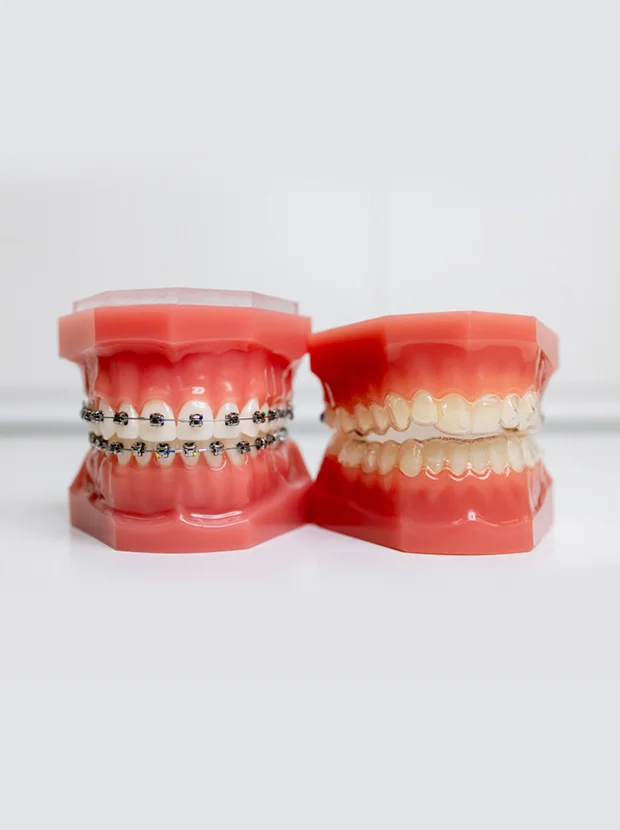
While people may connect metal braces to children or teens, they are still an effective form of dental correction for patients of all ages. For many years, metal braces remained the only option to correct crooked and crowded teeth. Braces involve metal brackets glued to the enamel of each tooth. Metal wires are laced between the brackets to help shape and mold teeth over time. The wires placed on the bracket can sometimes be the same color as tooth enamel so they are less noticeable; however, most of them are metal/silver. Patients also have the option to choose multiple colors to add their own unique style to their braces.
Metal braces are irremovable and stay in place for the duration of treatment. They may be a good option for patients who are concerned about losing their aligner trays or do not want to have to change out trays. Treatment time varies by case, but the average for teens tends to be approximately two years. Most patients require a monthly or bi-monthly check-up, so the practitioner can see how teeth shift, adjust wires accordingly, and ensure there are no issues that need to be corrected.
Invisalign
Invisalign offers a clear set of plastic aligners called "trays" customized to fit each patient’s mouth. Invisalign uses 3-D imagery of the patient’s teeth to configure and customize the trays to ensure the right fit. The smooth plastic used to create the trays remains BPA-free, providing comfortable wearing. They must be checked and replaced throughout the treatment for both teens and adults to align teeth into the proper position.
Invisalign aligners are removed while eating, drinking, and engaging in activities without interference or concerns about oral injury. Invisalign should be worn approximately 21-22 hours a day for 6-18 months, depending on the issue that needs correcting. Follow-up visits take place approximately every 6 to 8 weeks to change trays. Trays will need to be fitted and customized throughout the treatment as they keep the teeth moving at a gradual pace.
“While metal braces and Invisalign provide the same end result, it is important to understand the differences and similarities between the two.”
Effectiveness
The choice between braces and Invisalign depends largely on preference and the issue that needs correcting. The success rate of Invisalign depends on patient adherence — they must wear the trays to enjoy the benefits of a straighter smile. The trays should be worn for at least 22 hours a day for the treatment to be successful or go as desired.
Braces have also produced positive results in many individuals because of their durability and strength. Individuals with complex dental issues may require metal braces in order to align their teeth. For those with complex dental issues or worry about self-discipline in ensuring continued wear of the trays, metal braces may be a better option. With braces, patients can straighten their teeth without the worry of keeping track of the trays or cleaning them frequently.
“The choice between braces and Invisalign depends largely on preference and the issue that needs correcting.”
Invisalign for Specific Conditions
Invisalign can be helpful for those with mild to moderate dental issues. Treatable cases through Invisalign treatment include overbites, underbites, cross bites, gapped teeth, open bites, crowded teeth, and mixture of baby and permanent teeth. However, each case differs under each of these treatments, and some cases may be too complex to treat with Invisalign.
Complex dental issues requiring traditional metal braces include, but are not limited to, early, late, or irregular loss of baby teeth; delayed eruption of adult teeth; teeth that do not meet at all; missing or extra teeth; incorrect jaw positioning; jaw-clicking; jaw-joint disorder; and respiratory or eating issues. During the consultation appointment, an orthodontist is able to fully understand the patient’s case, in combination with other factors, and make a professional suggestion for the appropriate treatment type. In some cases, the patient may qualify for either treatment and be able to choose themselves.
“Invisalign can be helpful for those with mild to moderate dental issues.”
Preventing Teeth From Shifting
After removing traditional braces, most patients must wear a retainer at night to keep their teeth from shifting. If the retainer is not worn, teeth will likely move and require further treatment to straighten them again. Once braces are removed, the patient’s teeth must be kept aligned. Most patients require a positioner or retainer, typically worn overnight, to keep their teeth aligned after removing braces. With Invisalign, patients do not have to wear a retainer after treatment as teeth generally stay straight after the course of treatment.
However, Invisalign does require patient adherence as they are responsible for keeping them safe, clean, and in proper condition. Patients who do not adhere to the guidelines given to them may also experience shifting and undesired results by the end of treatment. If the patient misplaces or damages their Invisalign trays, they can be replaced but may delay treatment. Invisalign Teen comes with replacement aligners at no additional cost, as it remains common for teenagers to accidentally throw them away or misplace them once they remove them for eating or engaging in activities.
“With Invisalign, patients do not have to wear a retainer after treatment as teeth generally stay straight after the course of treatment.”
Dietary Restrictions
When wearing braces, patients must only eat foods that are "braces safe." Gum and hard foods, such as candies or nuts, are typically off-limits to prevent damage to the braces or injury to the teeth. Invisalign patients do not have dietary restrictions as they remove the aligners while eating and drinking. However, we do recommend patients eat healthy, nutritious food to keep their oral cavity clean during orthodontic treatment.
In order to care for both braces and Invisalign trays, we advise patients to practice enhanced oral hygiene habits. With braces, patients should brush their teeth at least twice daily and use a water flosser or floss designed for braces at least once daily. There are various other tools for patients with braces, especially those with more complicated issues. With Invisalign, patients should remove their aligners while brushing and flossing. The aligners themselves should also be thoroughly cleaned during oral hygiene care to keep them clean and free of food particles or debris.
“Invisalign patients do not have dietary restrictions as they remove the aligners while eating and drinking.”
Questions Answered on This Page
Frequently Asked Questions
New patients and emergency appointments welcome
Invisalign® Terminology
Aligner Trays
With Invisalign® treatment, the patient will receive a series of aligner trays and swap out each one for the next one in the series every two weeks in order to gradually straighten the teeth.
Blue Compliance Indicator (Invisalign® Teen)
The blue compliance indicator is a small blue dot on the aligners that will fade from blue to clear in order to indicate if the patient is wearing the aligner for the proper amount of time and where the patient is in the Invisalign® process.
ClinCheck® Software
ClinCheck® software allows professionals to map out the straightening process the patient’s teeth will go through with Invisalign® in great detail.
Gum Line
The gum line is the line in the mouth where the teeth and gums meet. If a patient struggles with gum recession, then the gum tissue around the teeth may begin to wear away.
Incisal Ridges
Incisal ridges are the portion of the crown of the tooth that makes up the incisal portion and can be a direct cause of overbite if they are extended too far.
iTero Element® Scanner
An iTero Element® scanner allows professionals to create a 3D image of the patient’s teeth in minutes and predict what it will take to move the teeth into proper alignment.
Malocclusion
Malocclusion is the condition in which the upper and lower teeth do not meet properly when the bite is closed. Conditions of malocclusion can include overbite, underbite, crossbite and open bite; all of which are treatable with Invisalign®.
Overbite
An overbite is a type of malocclusion that occurs when the upper teeth jut out over the lower teeth, covering them and causing other issues.
Polyurethane Resin
Polyurethane Resin is a USP Class VI medical grade, high molecular weight compound that makes up the Invisalign® aligners.
SmartForce Attachments
SmartForce attachments are small attachments that professionals place on the patient’s teeth before placing aligners to help move the teeth.
Smart Track® Material
Smart Track® material is in Invisalign® aligners to increase comfort, improve control of movement, increases the speed of treatment and applies a gentle force to the teeth over time.
Smile-Scan
Smile-Scan analyzes the way a patient smiles by measuring the position of the mouth and eyes before giving a score.
Vivera® Retainers
Vivera® retainers are a type of retainer that consists of clear plastic material and helps to maintain orthodontic corrections after a treatment.